How Fast Can a New Website Rank? Ours Took a Week.
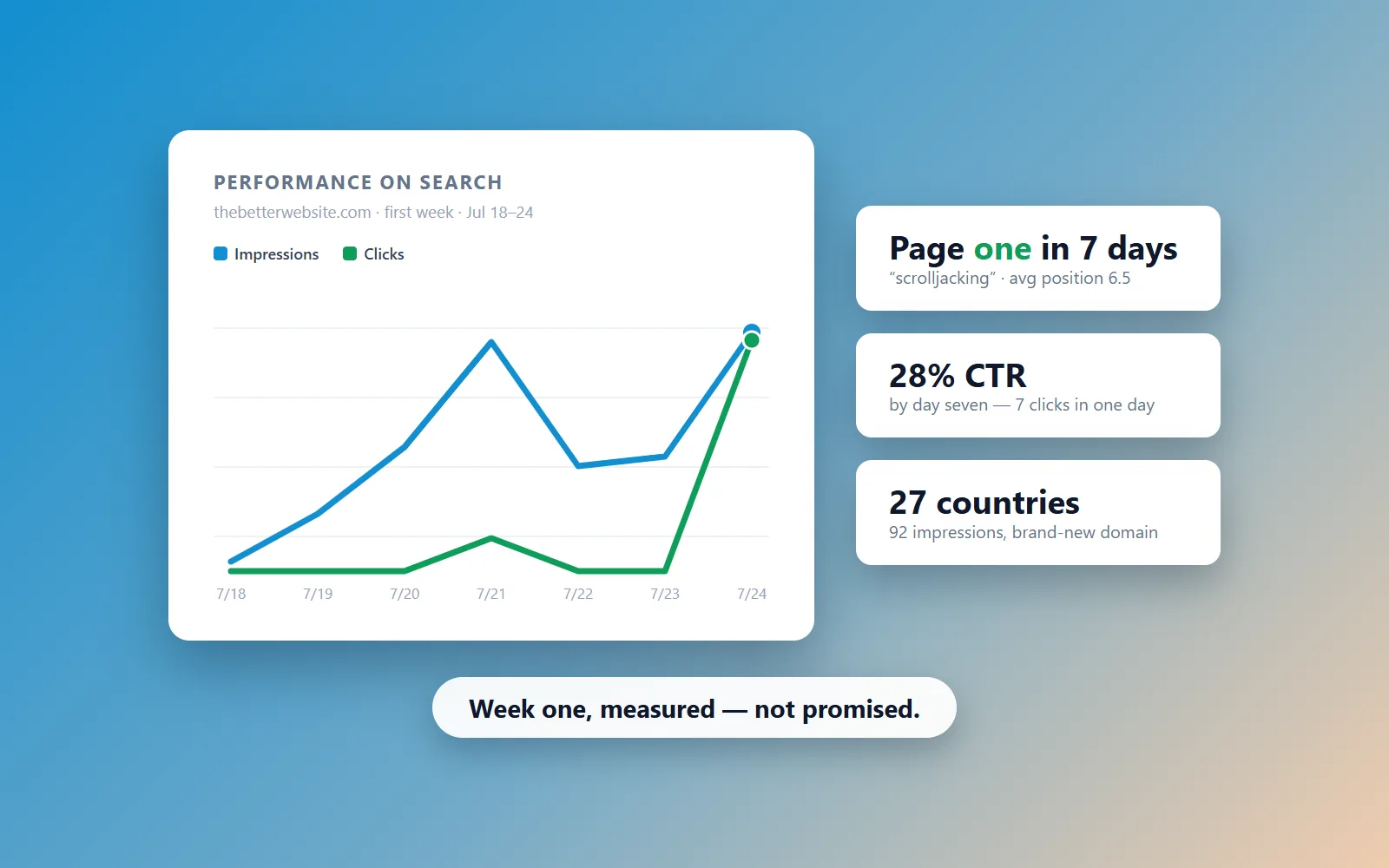
“How long does SEO take?” is the question every web person gets asked, and the stock answer is some shrug between six months and a year. I can’t tell you that’s wrong in general. I can tell you what happened here, because this site is brand new, it wasn’t even finished when the posts went up (there was literally an under-construction badge on the home page) and I have the Search Console export in front of me. Measurable rankings in seven days. Small ones. But real, and the why is more useful than the brag.
The setup
Between July 15 and July 18 I published a cluster of posts targeting one topic: scrolljacking; what it is, whether it hurts SEO, how to make it accessible, the API behind it. Not because those are the biggest keywords I could think of, but because they’re the ones this site can actually own: a technique I use, criticism I can answer from experience, and (the part you can’t fake) a live site demonstrating every claim. That was the whole strategy. Pick a fight you can win, then show up to it with receipts.
The numbers, straight from Search Console
The export covers July 18 through 24, the first week after the cluster finished publishing. Day one: a single impression, average position 14. Google had found the posts the day the last two went live. By day four the average position had climbed to 8.8 and the first click landed. Day seven: seven clicks in a single day at a 28% click-through rate; for context, a #1 result is usually happy with 30%.
The line that matters most: for the query “scrolljacking”, the site averaged position 6.5 for the week: page one, on a domain Google had barely met. Impressions came from 27 countries. And my favorite row in the whole export: somebody found the definitional post at position 22 (page three) and clicked it anyway. People genuinely dig for this answer, and almost nobody is writing it.
The part I can’t prove with an average
Here’s the anecdote, labeled as one. Ask Google whether scrolljacking is bad for SEO (the actual question, phrased like a person) and everyone I’ve had try it sees my post about exactly that in the #1 spot. Search Console won’t confirm it, because it reports averages across every query, day, and country in the window, and a week of climbing drags the average down. So I’m not claiming a #1 average. I’m saying: google it yourself. That’s the kind of claim I like: the reader can run the experiment.
Why it worked
No magic, three decisions. First, the keyword pick: specific terms with real search intent and thin competition, where genuine expertise shows. Second, the site practices what the posts preach: hand-coded rather than built on WordPress, pages a few kilobytes heavy, real URLs for every screen, content in the HTML before any script runs. When your article about site speed loads instantly, the argument makes itself. Third, the cluster is wired together: every post links its siblings and funnels to the web development page, so one page’s authority feeds the rest.
The honest caveats
Eight clicks and ninety-two impressions is a rounding error for an established site, and a week of data is weather, not climate. The terms I won are winnable terms; try this with “best pizza near me” and report back. And I said it in the SEO post and it’s still true here: anyone who promises you ranking outcomes is selling something. What I’ll actually claim is smaller and more useful: a brand-new, unfinished, hand-coded site got itself indexed, onto page one, and clicked, in one week, for the cost of writing things I know to be true.
If you want the architecture that made Google this comfortable this fast, it’s all on the web development page. If you want a site that starts its first week the way this one did, well, that’s a conversation.