How Do I Get My Website Into AI Answers?
Somebody types a question into ChatGPT instead of Google. It answers in a paragraph, names two or three companies, and that is the whole search. No list, no ten blue links, no page two. You were either named or you were not.
You get named by being the clearest source of a specific answer, written as plain text on a real URL that a machine can read without running anything. That is the job. It is considerably less exotic than the people currently selling it to you would like, and most of it is work you already know how to do.
The concession first, because it is a real one. This genuinely is a shift, not a rebrand of search. Being findable used to mean ranking in a list, where being tenth still put you on the page and somebody stubborn could still scroll to you. Increasingly there is no list. Something reads a handful of sources, writes one answer, and cites two of them. Tenth is not a worse position any more. It is no position.
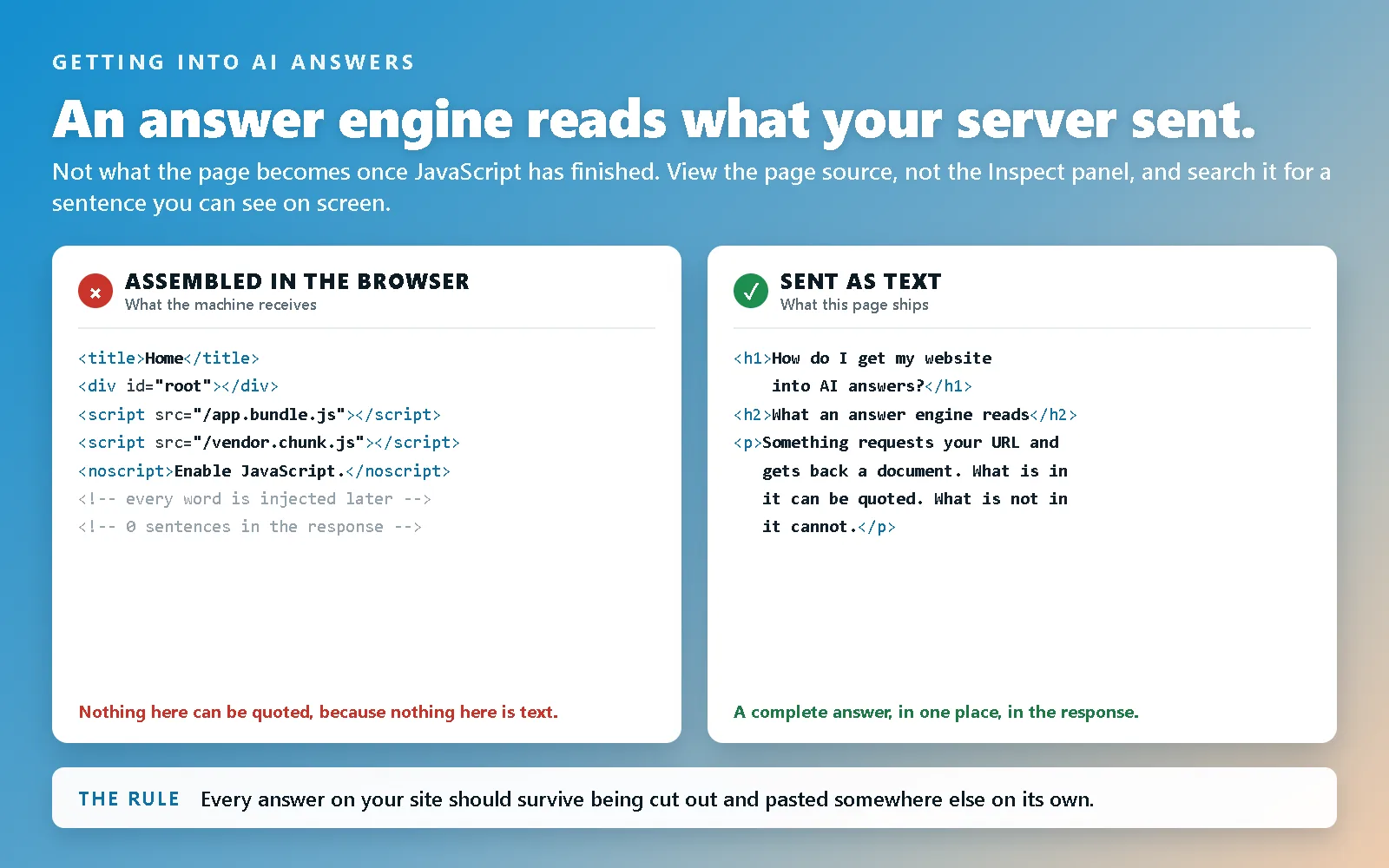
And here is the part that nobody selling you a solution leads with. What an answer engine reads is the HTML your server hands over before a single line of your JavaScript has run. Not what your page looks like. Not what it becomes half a second later. The raw text in the response. Everything else in this post is downstream of that one sentence, and you can check it on your own site in about a minute.
It is not an llms.txt file, and I say that as somebody who ships one
If you have read anything about this in the last year you have been told to add an llms.txt file. It is a plain text file at the root of your site listing your pages with a sentence about each one, so a language model can find its way around without crawling the lot. It is a nice idea, it costs almost nothing, and this site has one.
It is also not the answer, and it is worth being blunt about why. As I write this in August 2026, I have not seen a single major AI company commit to reading it. Google’s search relations people have publicly compared it to the old keywords meta tag, which is not a flattering comparison: the keywords tag was a box where you told search engines what your page was about, and search engines stopped believing it roughly the moment they worked out that anybody could type anything into it.
Go and check that rather than taking my word for it, because it is exactly the sort of claim that ages. But notice the deeper problem, which does not age. An llms.txt file is a description of your pages. If the pages are not worth quoting, a tidy list of them changes nothing. It is a table of contents for a book nobody wanted to cite.
So why ship one? Because it is a few dozen lines of text, it costs nothing to keep accurate, it is a fair summary of what is here, and if something does start using it I would rather already be in the file. That is the whole argument. “Cheap, honest, and it might help” is a perfectly good reason to do something. It is a terrible thing to build a strategy on.
What an answer engine actually reads
All of these systems, whether it is a search engine writing an answer above the results or an assistant going off to browse on your behalf, start the same way an ordinary search crawler does. Something requests your URL and gets back a document. That document is the raw material. What is in it can be quoted. What is not in it cannot.
The failure that catches most sites is that their words are not in it. If your site is built so the server sends a nearly empty shell and JavaScript assembles the page once it reaches the visitor, then the text a person reads was never in the response. Google will usually render the page eventually and see it anyway. The rest are far less generous, and even Google’s patience is a queue you are standing in rather than a promise.
Here is the check, and it takes a minute. Open your busiest page, copy a sentence you can see on the screen, then open that page’s source and search it for your sentence. Ctrl and U in Chrome, Edge or Firefox, or right click and choose View Page Source.
The important word is source, and this is where people give themselves a false pass, so it is worth being precise about it. Do not use Inspect. The Inspect panel shows you the live document as it stands right now, after your JavaScript has finished putting things into it, and injected text sits in there looking perfectly ordinary, because by that point it is ordinary. It is real markup in a real page. It just was not in what your server sent. View Page Source shows you that instead: the raw response, before anything ran. They are two different documents, and the gap between them is the entire subject of this post. Inspect will cheerfully tell you everything is fine on precisely the sites where it is not.
If your sentence is in the source, good, you are readable, and the rest of this post is about being worth reading. If what you find instead is a few dozen lines of script tags and an empty div, then everything you have written is invisible to anything that will not run a full browser to look at you.
Two other ways to see the same thing, if you want to be certain. Turn JavaScript off in your browser settings and reload the page: whatever disappears was never in the response in the first place. Or, if you are comfortable at a terminal, run curl against the URL and read what comes back, which is character for character what the machine got.
This is one of the quieter advantages of a hand-coded website written from an empty file. Nothing here is assembled after arrival, so every word of every page is in the response. That was not a clever move made in anticipation of chatbots. It is just what happens when there is no rendering layer sitting between the writing and the reader.
Why it quotes one page and not another
Say two sites both answer the question and both are perfectly readable. One gets quoted. The difference is usually structure rather than quality, which is annoying, and useful.
Something writing an answer is looking for a line it can lift and stand behind. Not a page. A line. So the pages that get quoted are the ones where the answer exists as a complete statement in one place, and the pages that do not are the ones where the answer is genuinely there but assembled: a bit of it in the second paragraph, the qualification four paragraphs down, and the conclusion at the bottom, which only makes sense if you read the middle.
A human reader assembles that quite happily. That is what reading is. Something looking for one quotable line finds nothing to take, so it takes the site that said the whole thing in one go.
Which gives you a rule you can apply to anything you write. Every answer on your site should survive being cut out and pasted somewhere else on its own. If a sentence needs the paragraph above it to make sense, it is not an answer, it is a continuation. Name the subject instead of saying “it”. Put the whole claim in one sentence and explain it underneath, rather than building up to it and revealing it at the end like a magician.
Ask the question, then answer it immediately
The most reliable structural habit, and it barely qualifies as a technique: write your headings as the question somebody actually types, and make the first sentence underneath the direct answer.
Not a preamble. Not “there are a few things to consider here”. The answer, first, followed by everything that makes it credible. This post does it, every question on our FAQ page does it, and the reason is not that machines enjoy it. It is that a page organised this way is easier for a person in a hurry, and the machine is doing an impression of a person in a hurry.
Two habits go with it. Answer the question you were asked before you answer the question you wish you had been asked, because a page that dodges in its first line is a page nothing can quote. And be willing to give a straight no. Careful writing that commits to nothing is unquotable by construction. Nothing has ever cited “it depends”.
Structured data is a label, not a lever
Structured data is a small block of machine-readable notes inside your page saying what the page is. This is an article, published on this date, by this company, which is in Raleigh, and here is a question with its answer.
It does not make anything true and it does not push you up anything. What it removes is ambiguity. Something reading your about page has to work out for itself that the business name, the address and the email belong together and refer to one entity. Structured data simply says so. That is the entire value and it is a real one, because being confidently understood is most of being cited.
One rule matters more than the rest: what you mark up has to be exactly what is on the page. If the answer in your structured data is a tidier version of the answer a visitor reads, you have written two different answers and asked to be trusted about which one is real. Ours are copied across word for word, deliberately, and when one changes they both change.
The unglamorous half
Everything so far is about being quotable. The rest is about being reached and being believed, and it is the same work it has always been.
Be fast. Something on a crawl budget that gives up on your page has not made a judgement about your content, it just does not have any of it. Slow sites get sampled less, and the fixes for making a website faster are boring and well understood.
Give everything a real URL. If it cannot be linked to, it cannot be cited. Anything living behind a tab, a modal, an accordion that fetches on click or an infinite scroll may as well not exist to anything that is not a person with a mouse and some patience.
Be mentioned somewhere that is not your website. These systems have a strong sense of what is corroborated, and a claim only your own site makes is a claim with one source. Being written about elsewhere does more for this than any amount of editing your own pages.
Be right, in public, about something narrow. The single biggest thing that makes a small site quotable is having a real position on a specific subject, stated plainly, that the large generic pages are too cautious to state. A hundred pages of safe summary are not competing with the encyclopaedias. Six pages of specific, defensible, first-hand answers absolutely are. That is also how this domain reached page one in a week, and it was not luck. It was picking a fight small enough to win.
What this site does, and the part I cannot prove
The receipts, since I have just spent a post telling you to be checkable.
Every word of every page here is in the HTML when it arrives, with no rendering step in between. Every page carries structured data describing itself and the studio behind it, and every marked-up answer matches the visible one exactly. The FAQ answers are written as self-contained sentences on purpose. There is an llms.txt. Nothing is hidden behind a tab or a modal. The site fetches nothing from anybody else’s server, so there is very little standing between a request and the words.
Now the honest part. I cannot show you a dashboard proving how often a model cites this site, because that dashboard does not really exist yet. Search Console folds AI Overview clicks in with everything else, referrals from assistants arrive in analytics as a thin and unreliable trickle, and something that reads you, uses you and names you without ever sending anybody through is invisible in every tool I have. Anybody quoting you a precise figure for this is quoting you a model of it.
So here is what I would want said to me. Every item on that list is also just good practice: readable HTML, real URLs, fast pages, clear answers, accurate markup. If the AI half of this turns out to be smaller than everybody currently believes, none of that work is wasted, because it is the same work that has always made a site findable, and it is the same work that makes a page usable by somebody on a screen reader. That is the honest case for doing it, and it does not require anybody to be right about the future.
How to get your website into AI answers: five things to check this afternoon
In rough order of return:
- View the source of your busiest page (the source, not the Inspect panel) and confirm your real sentences are in it.
- Take the three questions you most want to be the answer to, make each one a heading, and put the answer in the sentence directly underneath.
- Find an answer that is currently spread across four paragraphs and rewrite it so the whole claim lives in one.
- Check that your structured data, if you have any, says exactly what your page says.
- Look at what is only reachable by clicking something, and give the parts that matter a URL of their own.
None of that needs a vendor, a subscription or a rebuild, and none of it stops being useful if the tools change again next year, which they will.
And if you would rather your site did all of this by construction instead of by cleanup, that is the argument for building it this way in the first place. A page that is nothing but text, structure and meaning is readable by a person, a screen reader, a search crawler and a language model, for the same reason and with no extra work for any of them. Tell me what your page is doing and I will tell you what is standing between it and being quoted, even when the answer is that you can fix it yourself before lunch.