Are “Free” Websites Really Free?
If you own a small business and you have scrolled Facebook or Instagram lately, you have probably seen the ad. A free website for your business, done this week. The “free” is in big letters, and the monthly payment is saved for after you've already contacted them.
I get why it works. And if you have already signed up for one, you might be wondering what you actually bought.
The short answer
No. A “free” website is always paid for, just not up front. There are two kinds. A free plan on a website builder like Wix or WordPress.com costs nothing in cash, and you pay with the builder’s ads on your pages, an address on their domain instead of your own, and steady pressure to upgrade. A “free website” from a design company, the kind in the social media ads, costs nothing on day one and is paid for monthly for as long as you keep it, which over a few years often adds up to more than a custom website would have cost.
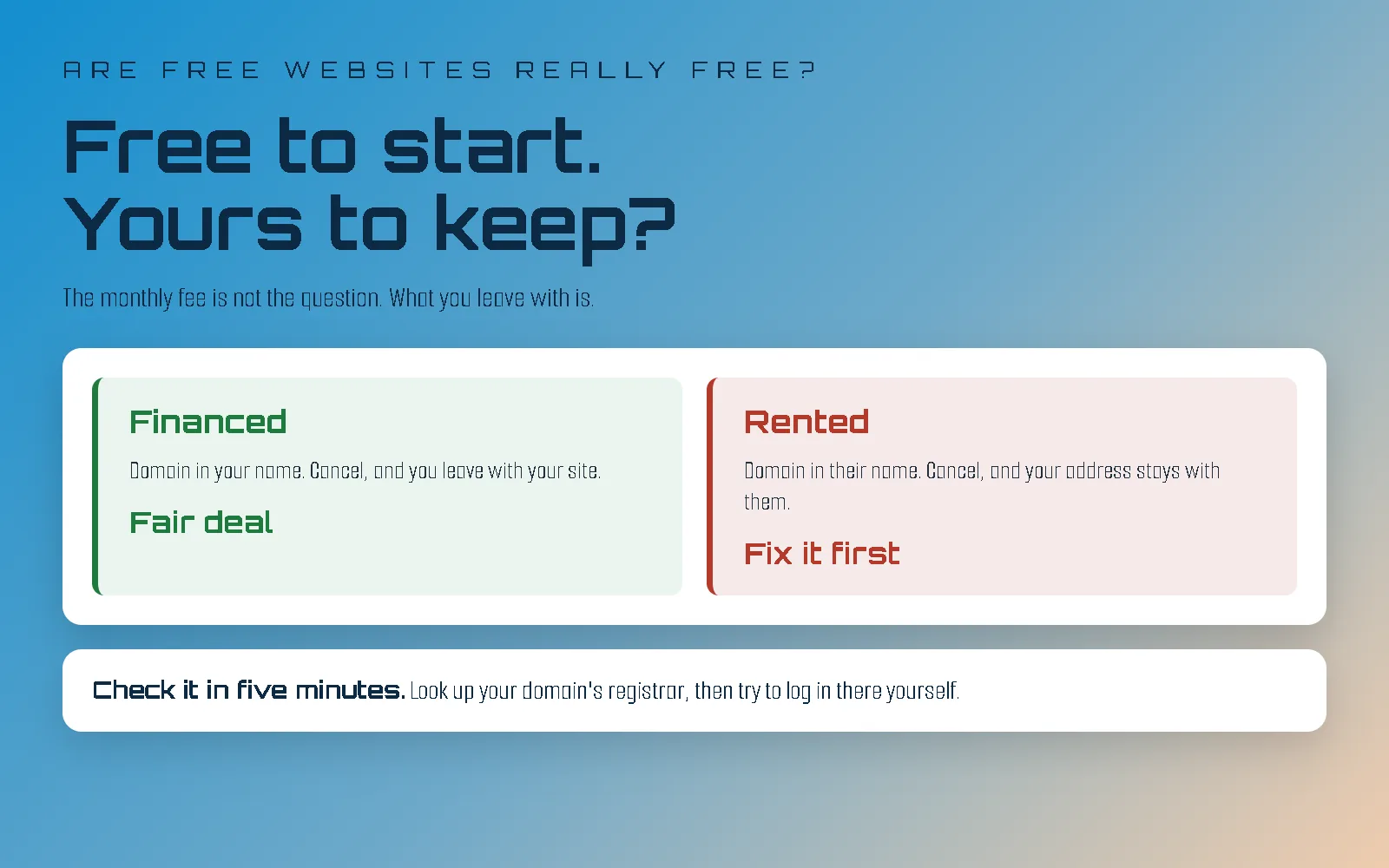
Either way, the question that matters is the one the ads never answer: what do you leave with when you stop paying? If the answer is your domain, your words and a working copy of your site, you were financing it. If the answer is nothing, you were renting, and the landlord holds your address.
What is the catch with a free website builder?
The free plans on the big builders are honest about what they are. They are a sample, and they are built to make you want the paid version. For a hobby, a personal page or a test run, they are genuinely fine. For a business, the catches are the same almost everywhere:
- Their address, not yours. Your site lives at something like yourname.wixsite.com or yourname.wordpress.com instead of yourbusiness.com, and customers notice.
- Their ads and their logo on your pages. Removing them is what the paid plan is for.
- No email at your own domain. you@yourbusiness.com needs a domain you own, which the free plan does not give you.
- Hard to leave. What you build on a builder mostly stays on that builder. Wix, for example, offers no way to move your site to another host.
None of that is hidden. The rest of this post is about the other kind of "free", where the catch is.
Why the monthly offer appeals
I want to be fair about this part, because the appeal is real and it is not stupid.
Nothing up front is a real benefit. A new business has a lot of bills on day one, and a website is easy to put off. Paying each month instead of a lump sum is how most people buy cars, phones and furniture, and nobody thinks less of them for it.
The monthly fee usually covers most of the basics. Hosting, the security certificate, small edits, and somebody to call when something looks wrong. If you would never touch your own website and just want it handled, that plan does have some value.
It is fast (the process, not the site). Most of these sites are built from a template the company already has, more and more often with AI doing the heavy lifting, so you can be online in days. For a business whose website is a small part of how it wins work, that is not a bad option.
But be honest with yourself about which of those is doing the work. The only strong argument for one of these plans is that you need a site now and do not have the money for one yet. That is a real situation, and plenty of businesses are in it. It is just the only one.
Why “free” is the wrong word, and a dishonest one
You are still paying for it, just in monthly fees and limited ownership rather than a one-time payment. I would not call the model a scam. A car lease is not a scam either. But nobody advertises a lease as a free car.
When a car lease ends, you know exactly what you hand back, because it is written in the contract and you read it. A “free” website sells you on the start and leaves the end to the fine print.
And the word itself tells you something. I would take a company that advertises its monthly price over one that calls the same thing free, every time, no exceptions. A website is a relationship that lasts years, and a company willing to stretch the truth in the first two seconds of its ad is showing you how it will answer every question after that.
What you are actually paying for
It helps to do the arithmetic once, because a small monthly number feels smaller than it is. A plan at $150 a month is $1,800 a year. Over three years that is $5,400; over five, it is $9,000. A business website usually stays up for years, so that five-year number is the real price of the site.
On the surface, that is an ordinary price. Underneath, you are paying custom-website money for a template, the same one the company sold to everybody else that month. What that price does not usually include is the part of a website that actually wins work: looking at your market, looking at what your competitors do, and building something for your business rather than filling in a layout.
I would also not assume all the bases are covered. A template filled in at speed is rarely tested for visitors who use a screen reader or a keyboard to navigate, or tuned to load quickly on a phone, and those are the two things that most often go wrong without anybody noticing. You can check speed yourself in Google’s PageSpeed Insights, and why website accessibility matters shows two accessibility problems you can spot without being a developer. Outside the technical side, content generated in a week isn't sent through a competitor analysis or audited for search engine visibility.
What you didn’t consider: your domain
Your domain is your address on the internet, the yourbusiness.com part. It is on your business cards, your truck, your email, every link anybody has ever shared to your site, and every bit of ranking you have built up on Google. Of everything involved in a website, it is the one thing you cannot easily replace.
Most honest monthly companies register the domain in your name, so it stays yours whatever happens to the website. Some register it in their own name, as part of “taking care of everything for you.” That sounds like a convenience. It means the company you want to leave owns the address your customers know you by. Then leaving is not a matter of cancelling. It is a negotiation, and you are not the one holding the cards.
That is the line between financing and renting, and it is a line you can check.
Check it yourself in five minutes
No code, and no need to ask anybody.
One. Find out who your domain is registered with. Go to ICANN’s domain lookup (ICANN is the organization that oversees domain names) and type in your domain. Look for the line that says Registrar. That is the company your domain lives with, something like GoDaddy, Liquid Web, Squarespace or Cloudflare. Do not worry if the owner’s name says “redacted”; most domains hide it now for privacy.
Two. Try to log in there. Go to that registrar’s website and log in with your own email. If you can, and you see your domain in your account, it is yours. If you have never had an account there, or the only login belongs to your website company, it is theirs in every way that counts, whatever anybody told you on the phone.
Three. If it is theirs, ask for it now. Not when you want to leave. Ask your website company to move the domain into an account in your name, today, while everybody is still getting along. A good company will do it without a fuss, and that answer tells you a lot about the rest of the relationship.
Can you take your domain away from a website company?
Yes, and it is not difficult. Moving a domain into your own account, or to another registrar, is a few clicks and an approval email, and done properly your site and email stay up the whole time. The one real limit is a short lock, usually a month or two, right after a domain is first registered or moved, when it cannot be moved again.
So be skeptical of anybody who says it is complicated, risky, or means your site will be down for days. If the company also runs your email, that needs moving carefully, but careful is not the same as difficult. If you are hearing excuses instead of a date, that is the answer to the question.
Six questions to ask before you sign
If you are looking at one of these offers now, ask these and get the answers in writing. A good company answers all six without flinching. The answers you are hoping for are in brackets.
- Whose name is the domain registered in? (Yours, in an account you can log in to.)
- Is there a minimum term, and how do I cancel? (Month to month, or a short minimum you agreed to on purpose, and cancelling is an email, not a hostage situation.)
- When I cancel, what do I get? (Your words, your photos, and ideally a copy of the site itself that another developer could put back online.)
- Are there any fees to leave, to keep the site parked, or to come back? (No. Some companies charge to store a cancelled site and again to switch it back on.)
- Who owns the words and photos you made for me? (You do. If they wrote your copy or took your photos as part of the plan, you want to be able to use them anywhere.)
- Is it built for every visitor and every phone? (A plain yes, with how they checked: tested for accessibility, and a good mobile score you can see for yourself.)
If a company will not answer one of these clearly, that is your answer. If you think you're being misled, let's have a conversation. Nothing gets under my skin more than professional dishonesty, and while I'll definitely pitch you a build, I won't make it out to be anything it isn't and I won't pretend an honest company is lying to you for a sale.
When a monthly website is the right call
When you need a site this week and the money for a real one is not there yet. Choose a plan with good answers to those six questions, from a company that tells you the monthly price up front, and treat it as a starting point rather than a home.
It is worth noticing that a plan like Squarespace is already an honest version of this, without the salesperson: you pay monthly, you own your domain and your words, you can edit it yourself, and you rent the design. I went through what that means when you want to leave in should I move off Squarespace. The terms are clear, and that is what makes it fair.
A monthly site is the wrong call when your website is part of what you sell. If clients judge your business by its site (an architecture practice, a studio, a venue), a template shared with every other customer of the same company is not going to say what you need it to say, however you pay for it.
How I do it, for comparison
I build sites up front, by hand, starting from your business, your market and your competitors rather than from a template. I'm not opposed to payments in installments, but I personally would rather spend my company's time building and optimizing than chasing monthly payments.
The finished site is yours: your domain, your words, and your design. Hosting and ongoing changes are a separate conversation about what you actually need. And if you ever leave, you leave with your site: a copy of the files that any developer can host. That is what the process looks like, start to finish.
It costs more on day one, and I will tell you that on day one. If your current site is on WordPress and the domain check turned up something you did not like, the WordPress post covers getting access to your domain and moving safely.
The honest answer
“Free” websites are not free. A free builder plan is paid for in ads, a borrowed address and upgrade pressure. A “free website” from a design company is paid for monthly, usually for longer and at a higher total than the ad lets on. The fair ones put your domain in your name and let you leave with what you paid for. The rest keep the one thing you cannot replace.
A custom site, honest pricing and a real developer behind it is the better deal for almost any business that can manage it. If you are looking at one of these offers, or you already signed up and the domain check did not go the way you hoped, send me a message. I will tell you what I see, including the case where your plan is fine for now and you should keep it.