Should I Build My Website With AI?
You can describe your business to an AI and have a website by the end of the afternoon. Some website builders will do it for you with a single button. It will have a homepage, a services page and a contact form, and it will look like a website.
That last part is the problem. Looking like one was never the hard part.
Should I build my website with AI?
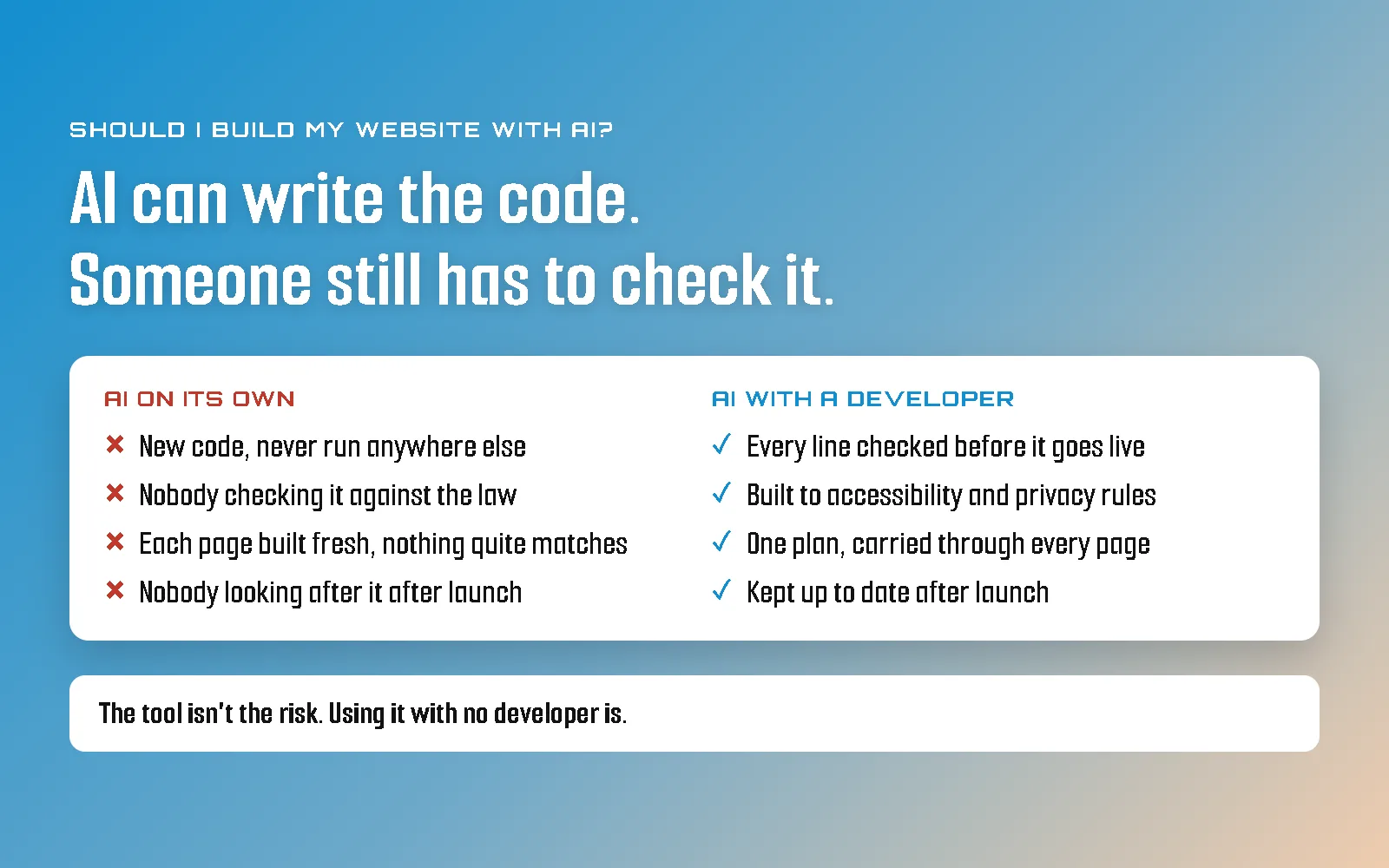
Not without a developer. In a developer's hands AI is a genuinely useful tool, and this site was built with AI assistance. On its own, AI is a page builder with no track record: you still can't see what is happening behind the scenes, and the code it writes has never run anywhere but your site.
If you have no development background, building with AI is no different from building with a page builder. You give it instructions, something appears, and what is underneath it is a mystery. The difference is what that mystery is made of.
Isn't an AI-built website just a page builder with extra steps?
It's worse in one specific way. A page builder's code runs on millions of other sites, so its problems get found and fixed. The code an AI writes for you is brand new, and your site is the first place it has ever run.
I have plenty to say about page builders like Elementor and Divi (and I said a lot of it in Should I Move Off WordPress?), but I will give them this: their code has been tested on an enormous number of sites. When something in it breaks, it breaks for thousands of people at once, somebody reports it, and it gets fixed. When someone builds something illegal, their compliance officer sighs and sends an email ordering it fixed.
AI doesn't hand you tested or vetted code. It writes new code every time you ask, shaped to your request. Nobody else has ever run it. If there is a hole in it, nobody else has found it, and the first person to find it will be you, someone trying to get in, or someone ready for an ADA lawsuit. AI poses more risks than just bad code, too: attackers use it to find holes faster than ever, which is a whole other topic and what happened with PHP2Shell this month.
The issues resulting from building with AI as your lead developer all boil down to the same cause. AI has a goal; a developer has a background.
What does a developer do that AI doesn't?
Writing the code was never the whole job. A developer knows the rules a website has to follow, checks every line before it goes live, and is the one who answers for it when something breaks.
- Accessibility law. Business websites in the US get ADA demand letters and lawsuits, and small businesses get them too. An AI will happily build you a menu that a keyboard can't open and a button a screen reader can't name, and the site will look perfect while it does. I go through why website accessibility matters, and what the ADA has to do with it in its own post.
- Privacy. If your site tracks visitors, many places require you to say so, and some require you to ask first. An AI will write you a privacy policy in seconds. It will describe a website in general, not the one you actually have.
- Security. Knowing which of the things a site can do that it shouldn't, and keeping what it runs on up to date after launch.
- Checking the AI's work. I use AI every day, and most of my time with it is spent reading what it wrote and deciding whether it is right. It is exactly as confident when it is wrong as when it isn't. You can't catch that without knowing what right looks like.
- Owning the quality. Somebody has to decide that "close enough" isn't, and then go back and fix it.
The difference most people won't notice
Before websites, I built high-end wine cabinets and cigar humidors for private clients, country clubs and yachts. It is the best reference I have for the kind of quality difference I mean.
On a cabinet with pairs of doors, a craftsman cuts the stiles and rails that meet from one piece of wood, so the grain carries straight across the seam. It's called grain matching, and a kit manufacturer doesn't bother with it. The gaps around each door are even, not "as close as we could get." Put that cabinet next to the same one without those details and people pick it every time, usually without being able to say why. (This one is sapele, by the way. If you have ever bought something sold as mahogany, there is a good chance it was sapele.)

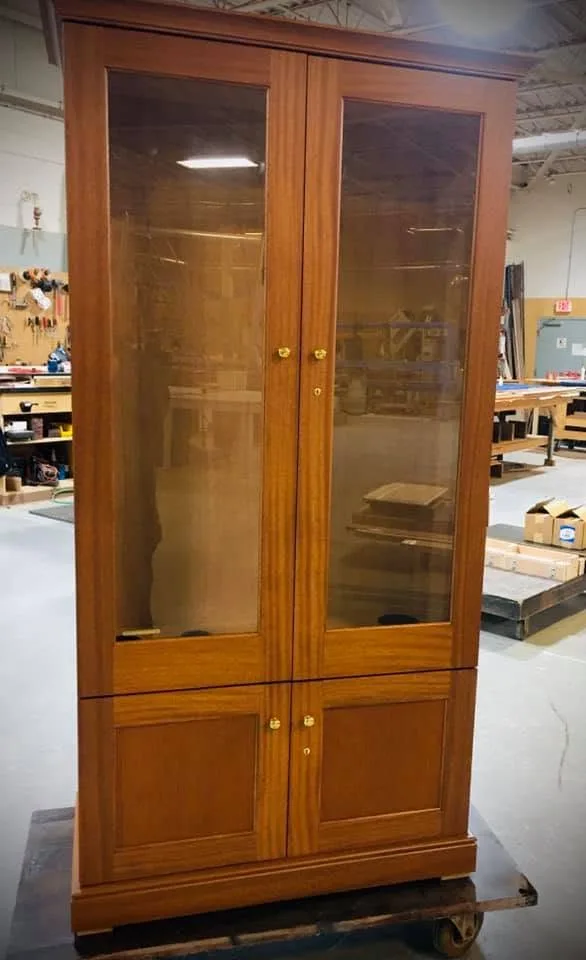
Websites are the same. Most visitors will never put a name to what is different about a site where every page was built to one plan and every detail was checked. They will just like it better, every time.
How can you tell a website was made by AI?
Look for inconsistency and lack of uniqueness. Nothing is exactly wrong, but nothing was decided either: pages and sections built separately that don't quite match, and each decision lacks creativity.
AI tends to build each page, and often each section, fresh. Ask it for a services page one day and an About page the next and the two are made separately. The buttons are a slightly different shape, the headings drift, and the space between sections is "as close as it could get." It is the same drift I described in Should I Move Off Squarespace?, just faster.
None of the checks below need any code. They are things you click and look at, on your own site or on one you are about to pay for.
- Open three pages side by side. Do the buttons match: same shape, same size, same style of wording? Do the headings look like they belong to the same site? Overall, is there a design theme being followed down to the smallest detail?
- Look at the gaps. Is the space between sections the same as you scroll down the page, or does it change from one section to the next without cause?
- Read the words out loud. "Elevate your experience. Unlock your potential." If a sentence could sit on any business's website, it was written for none of them.
- Tap everything on your phone. Effects that only work with a mouse do nothing on a phone, and AI builds a lot of them.
- Put the mouse down and press Tab. On a computer, press the Tab key over and over. You should be able to see where you are on the page at every press, and reach every link and button. If you lose track of where you are, so does every visitor who can't use a mouse. This one has a caveat, though: many developers overlook ADA compliance despite its legal repercussions.
What goes wrong on an AI-built website that you can't see?
The failures that cost the most are the quiet ones: a form that never delivers, a site a screen reader can't use, a privacy policy that describes some other website, and code that nobody is keeping up to date.
- Send yourself a message through your own contact form. A form can say "Thanks, we'll be in touch!" and send nothing at all. Does the message actually arrive? If your form doesn't work, you can bet the more complicated stuff doesn't either.
- Read your legal pages. Do they describe your business and what your site does? If you've got a popup that only shows once for each visitor and no cookie consent banner, you may be breaking the law without even knowing it.
- Ask who keeps it up to date. AI doesn't maintain anything. Whatever it built on, and whatever it added, needs looking after once the site is live. I go through why that matters in Do I Actually Own My Website?
Is it ever OK to build a website with AI?
Yes, in a developer's hands, and this site is the proof. AI does the boring-but-easy parts here, and I make every call that matters and check every line it writes.
On your own, it is fine for a placeholder, a hobby project, or testing an idea before you spend money on it. Just know what you have: something that might look finished but nobody has checked.
I wrote about how AI fits into my own work, and why I stopped worrying about it, in The AI Revolution, Revisited.
How I do it
AI does a lot of the typing on the sites I build. I decide what gets built, read what it writes, and end up rewriting most of it, keeping just the good stuff I hadn't thought of. Every page follows one plan, so the site is consistent from the homepage to the privacy policy. I test with a keyboard, send the form to myself, make sure the privacy policy describes what the site actually does, and keep it all up to date after launch.
The honest answer
An AI can build you something that looks like a website. Whether it holds up (whether it follows the law, works for every visitor and matches from one page to the next) depends on whether someone who knows what to look for has checked it.
If you have a site an AI built (or you're thinking about building one) and you would like a second opinion, send me a message. I'm happy to take a look, even if the answer is that it's fine for what you need.